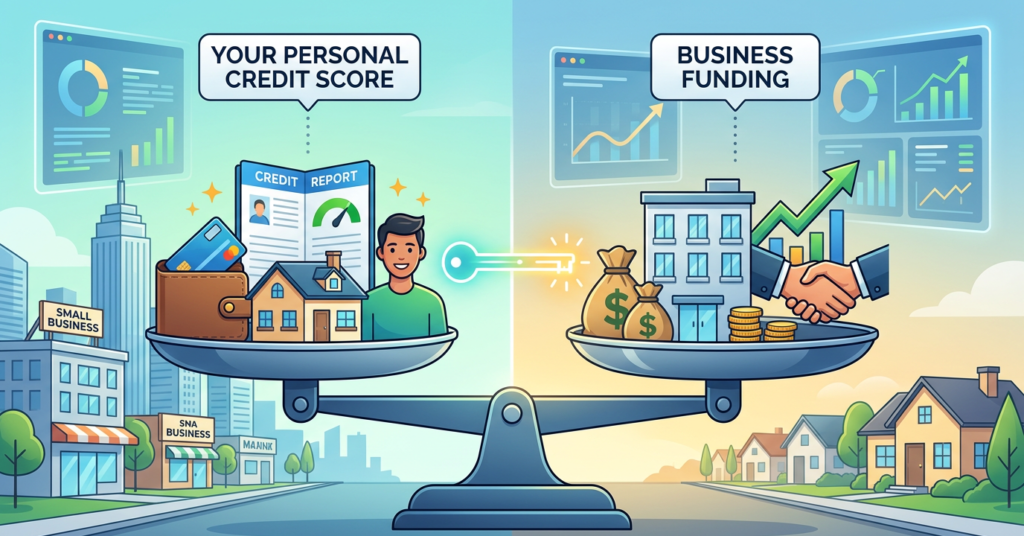
You have spent years building your business from the ground up. You have paying customers, a growing team, and a clear plan for what comes next — but when you apply for a business loan, the lender starts asking about your personal finances. It feels intrusive, maybe even unfair. Yet for thousands of UK SME owners, the personal credit score for business loan is precisely what stands between them and the funding they need to grow.
Understanding this connection is not just useful — it is essential. Whether you are applying for your first unsecured loan, exploring asset finance, or trying to recover from a slow trading period, your personal credit history is almost always part of the picture. This guide explains exactly why, how lenders use it, and — most importantly — what you can do about it.
Table of Contents
What Is a Personal Credit Score?
A personal credit score is a numerical rating — typically ranging from 0 to 999, depending on the credit reference agency — that reflects how reliably you have managed personal borrowing over time. In the UK, the three main credit reference agencies are Experian, Equifax, and TransUnion. Each uses slightly different scoring models, but all draw from the same underlying data: your payment history, outstanding debts, length of credit history, and any adverse events such as County Court Judgements (CCJs) or insolvencies.
For most individuals, a credit score is simply a measure of personal financial behaviour. For limited company directors and sole traders, it becomes something far more significant: a direct input into whether your business can access funding, and on what terms.
Why Your Personal Credit Score Matters for a Business Loan
Here is the reality that many SME owners discover too late: most UK business lenders — particularly for loans under £250,000 — will conduct a personal credit check on the director or directors of the applying business. This is especially true for:
- Sole traders, where there is legally no separation between the business and the individual
- Limited company directors, particularly when the business has a limited trading history
- Partnership structures, where personal liability is shared
The reason is straightforward. A lender is trying to assess risk. If a business is young, lacks strong financial records, or is seeking an unsecured business loan with no collateral to fall back on, your personal credit history becomes one of the most reliable predictors of how you manage financial obligations.
Think of it this way: your personal credit score tells a lender the story of how you have handled money before you even had a business. It signals discipline, reliability, and financial awareness — or the absence of those qualities.
According to the British Business Bank, access to finance remains one of the most significant barriers to growth for UK SMEs — and creditworthiness, including director credit history, plays a central role in whether applications succeed. (Source: British Business Bank)
Business Credit vs Personal Credit: What Is the Difference?
Understanding the distinction between business credit vs personal credit is crucial before you apply for any form of SME funding.
Personal Credit
Your personal credit profile is built on your history as an individual borrower. It includes mortgages, credit cards, personal loans, overdrafts, and utility accounts registered to your name or address. Missed payments, defaults, and CCJs remain on your personal credit file for six years.
Business Credit
A business credit profile, by contrast, is built around your registered company. It is based on Companies House filings, trade credit arrangements with suppliers, business bank account conduct, and any previous commercial borrowing. A strong business credit profile is built over time and is particularly important when a business reaches the point of applying for larger-scale or long-term funding.
The Critical Overlap for SME Directors
For the vast majority of small and medium-sized businesses in the UK, these two profiles do not operate in isolation. Many alternative lenders and high street banks assess both simultaneously. Your business credit score might be excellent, but a poor personal credit score for a business loan application can still lead to rejection — or a significantly higher interest rate.
This is particularly important for sole traders and small limited companies (typically with fewer than ten employees), where the director is often viewed as inseparable from the business itself.
How UK Lenders Assess Director Credit Scores for SME Funding
When a lender reviews your application for SME funding, they are conducting what is known as a dual assessment: examining both the commercial health of your business and the personal creditworthiness of its directors.
Here is what a typical SME funding credit check looks at:
Business-side factors:
- Months of trading history
- Annual turnover and profitability
- Outstanding debts and liabilities
- Cash flow patterns (often assessed via open banking)
- Industry sector and associated risk
Director-side factors:
- Personal credit score (via Experian, Equifax, or TransUnion)
- History of CCJs, defaults, or insolvencies
- Electoral roll registration (confirming identity and address stability)
- Any previous business failures or directorships of dissolved companies
The weighting given to each of these factors varies by lender and product type. However, the director’s personal credit score for a business loan application is rarely ignored entirely — even for well-established businesses.
Research from the Federation of Small Businesses consistently shows that a significant proportion of SME loan rejections are linked to creditworthiness concerns, including personal credit history of directors. (Source: Federation of Small Businesses)
Which Types of Business Finance Are Most Affected?
Not all business finance products treat your personal credit score equally. Understanding which products are most and least sensitive to director credit is essential when planning your funding strategy.
Unsecured Business Loans — Highest Sensitivity
With no asset pledged as collateral, an unsecured loan is entirely reliant on the lender’s confidence in your ability to repay. Your personal credit score for a business loan of this type carries significant weight. A score below 600 (Experian scale) will often result in either rejection or a materially higher interest rate.
Explore Pello Pay’s unsecured loan options if you want to understand what products may be available for your profile.
Secured Business Loans — Moderate Sensitivity
When you pledge an asset — property, equipment, or another valuable asset — the lender has a fallback if you default. This reduces the weight placed on your personal credit score, making secured loans more accessible to directors with imperfect credit histories. Learn more about secured business lending through Pello Pay.
Asset Finance — Lower Sensitivity
Because the financed asset itself acts as collateral (the lender can repossess it), asset finance products are often more forgiving of a lower director credit score. This makes them a popular route for businesses that need equipment, vehicles, or machinery but have a limited personal credit history.
Short-Term and Emergency Loans
These products are designed for speed and are often assessed on business performance rather than personal credit alone. However, a history of CCJs or defaults will still be flagged. If you need immediate capital, Pello Pay’s emergency loan facility is worth exploring, as it connects you with lenders who specialise in flexible, fast-decision lending.
Invoice Finance
Personal credit has the least influence here. Invoice finance is secured against your outstanding receivables — what your clients owe you — so lenders focus primarily on the quality and reliability of your debtor book, not your personal score.
How to Check Your Personal Credit Score in the UK
Before applying for any form of business funding, every SME director should check their personal credit report. You are legally entitled to a statutory report from each agency, but there are also free services that give you ongoing access:
- Experian — Free credit score via CreditExpert trial or MSE Credit Club
- Equifax — Free via ClearScore (powered by Equifax data)
- TransUnion — Free via Credit Karma
What to look for when reviewing your report:
- Any CCJs, defaults, or missed payments you may have forgotten about
- Incorrect entries — errors are more common than people realise and can significantly drag down your score
- Accounts you no longer use that may have outstanding balances
- Whether you are on the electoral roll at your current address
- Any fraudulent activity registered against your name
If you spot an error, raise a formal dispute with the credit reference agency directly. Correcting a single inaccuracy can add meaningful points to your score within 30–60 days.
7 Proven Ways to Improve Your Credit Score for Business Finance
If your personal credit score for a business loan application is not where you want it to be, there are concrete, actionable steps you can take. Results vary based on your starting position, but meaningful improvement is achievable within three to six months in most cases.
1. Register on the electoral roll This is the single fastest, simplest action you can take. Lenders use it to confirm your identity and address stability. If you are not registered, do it today at gov.uk/register-to-vote.
2. Clear small outstanding balances first Multiple small defaults have an outsized negative effect on your score. Prioritise clearing these ahead of applying for business finance.
3. Keep credit utilisation below 30% If your personal credit card limit is £10,000, try to keep your outstanding balance below £3,000. High utilisation signals financial stress to lenders.
4. Avoid multiple credit applications in a short window Each hard search leaves a footprint on your file. Multiple applications within weeks of each other signal desperation to lenders. Space applications out.
5. Ensure your business address and personal address are consistent Inconsistencies between your Companies House registration and personal credit file can create confusion and reduce your apparent stability.
6. Settle any outstanding CCJs A satisfied CCJ (one that has been paid) is far less damaging than an unsatisfied one. If you have old CCJs on your file, settling them — even years later — can improve your position materially.
7. Build positive credit history proactively If you have a thin credit file (not much history), consider using a credit builder card responsibly. Making small purchases and repaying in full each month demonstrates healthy financial behaviour without creating debt.
What to Do If Your Personal Credit Score Is Low
A low personal credit score does not automatically disqualify you from business finance. It does, however, shape the products, lenders, and terms available to you.
Options worth exploring include:
- Secured lending — Pledging property or a business asset reduces the lender’s risk and often makes approval more accessible regardless of personal credit score.
- Asset finance — As discussed, the collateral-backed nature of this product provides an accessible route for businesses that need equipment or vehicles.
- Invoice finance — If your business has strong receivables, this product can deliver working capital without significant reliance on personal credit.
- Specialist lenders — The alternative finance market in the UK includes lenders who specialise in adverse credit profiles. Through a platform like Pello Pay, you can access these lenders without submitting multiple separate applications.
- A guarantor arrangement — Some lenders will accept a personal guarantee from a director with a stronger credit profile, or from a third party such as a family member.
The key is to match your application to the right lender at the right time — not to apply broadly and hope for the best. Broad applications generate multiple hard searches, which further damage your score.
Ready to explore your options? Speak to the Pello Pay team today and get matched with lenders suited to your actual financial profile — including your current credit position.
How Pello Pay Helps SMEs Access Funding at Every Stage
At Pello Pay, we take a fundamentally different approach to business finance compared to platforms that simply churn applications through an algorithm. Our human-plus-technology model means you get the speed and convenience of a digital platform alongside real broker expertise that understands the nuances of SME lending.
Lender-Match Intelligence Built for Real Businesses
Our platform matches you with lenders who are genuinely likely to say yes — based on your full profile, not just your headline turnover. That includes understanding how your personal credit score for a business loan application will be viewed by different lenders, and routing your application accordingly.
Access to 50+ UK Lenders
High street banks are just one of many options. Through Pello Pay, you gain access to a market-wide panel of over 50 lenders — including specialist providers who assess applications differently, with more flexibility around director credit history.
A Full Spectrum of Finance Products
Whether you need a short-term loan to cover a cash flow gap, asset finance to fund new equipment, or a long-term loan to fund a major growth project, we can connect you with the right product. No one-size-fits-all approach. No pressure.
Transparent, Jargon-Free Guidance
We believe every business owner deserves to understand exactly what they are applying for, what it will cost, and why a lender is making the decision they are making. We explain everything in plain English — because smart funding decisions start with genuine understanding.
Frequently Asked Questions
Does a business loan affect my personal credit score?
It depends on the product and the lender. Some business loan products — particularly unsecured loans or those backed by a personal guarantee — will show up on your personal credit file. Always clarify this with your lender or broker before applying.
Can I get a business loan with a bad personal credit score?
Yes, in many cases. Products like secured loans, asset finance, and invoice finance are less sensitive to personal credit score. Specialist alternative lenders also serve businesses with adverse credit histories. However, rates and terms will reflect the additional risk to the lender.
How do lenders in the UK check my personal credit score for a business loan?
Most lenders use one or more of the three main UK credit reference agencies — Experian, Equifax, or TransUnion. Soft searches (which do not affect your score) are used at the quote stage; hard searches (which do leave a footprint) are typically conducted at the full application stage.
What personal credit score do I need for a business loan in the UK?
There is no universal threshold, as each lender sets its own criteria. As a general guide, a score of 700+ on the Experian scale (out of 999) will give you access to most mainstream business lending products. Scores between 500–699 may still qualify for secured or specialist products. Below 500, lenders become significantly more cautious.
How long does it take to improve a personal credit score?
Minor improvements — such as registering on the electoral roll or correcting an error — can take effect within 30 days. Rebuilding from significant adverse events (CCJs, defaults) typically takes 12–24 months of consistent positive financial behaviour.
Final Thoughts: Your Personal Credit Score Is a Business Asset
Your personal credit score for a business loan is not just a measure of your past financial behaviour — it is an active business tool. Managed well, it opens doors to competitive rates, flexible terms, and a wider choice of lenders. Neglected, it narrows your options and increases the cost of every pound you borrow.
The good news is that credit is dynamic. It responds to deliberate action. Whether you are starting from a strong position or rebuilding from a difficult period, the steps outlined in this guide will move you forward.
When you are ready to explore what funding is actually available for your business today — with full transparency and no obligation — the Pello Pay platform is built for exactly that moment.
Start your funding search with Pello Pay →