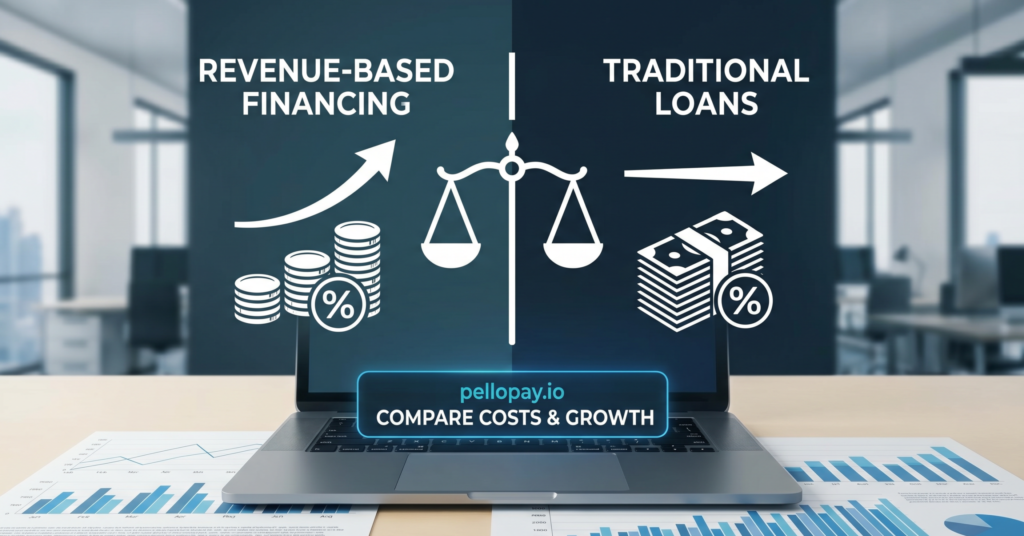
Is your business generating strong monthly revenue, but a traditional bank keeps saying no? You are not alone. Thousands of UK SMEs face this exact frustration every year — healthy turnover, genuine growth potential, and yet, the rigid criteria of a conventional lender leaves them stuck. Revenue-based financing UK is the model that is rapidly changing this landscape, giving growth-stage businesses a smarter, more flexible way to access capital without surrendering equity or pledging personal assets.
But the real question every business owner should be asking is this: which option actually costs less — revenue-based financing or a traditional business loan? The answer is nuanced, and it depends entirely on your revenue cycle, growth stage, and repayment preferences. This guide breaks it all down, clearly and honestly, so you can make the most informed funding decision for your business in 2026.
Table of Contents
What Is Revenue-Based Financing?
Revenue-based financing (RBF) is a form of alternative business funding where a lender provides a lump sum of capital in exchange for a fixed percentage of your future monthly revenue — until the total repayment amount (the advance plus a factor fee) is fully settled.
Unlike a traditional loan, there is no fixed monthly repayment schedule. Instead, you repay more when business is booming and less during quieter months. This makes it an extraordinarily flexible tool for businesses with seasonal or fluctuating income.
In the UK, RBF is most commonly used by:
- E-commerce businesses with strong online sales data
- SaaS companies with recurring subscription revenue
- Hospitality and retail SMEs with predictable card transaction volumes
- Service businesses with consistent monthly invoicing
The lender’s primary underwriting criterion is not your credit history — it is your monthly revenue performance. This opens the door for many businesses that traditional lenders would turn away.
Key Insight: Revenue-based financing is not debt in the traditional sense. There are no interest charges. Instead, you pay a one-time “factor rate” (typically between 1.1x and 1.5x the amount borrowed), which is agreed upfront.
How Traditional Business Loans Work in the UK
A traditional business loan in the UK works much like a personal loan — a fixed sum is advanced to your business, which you repay in structured monthly instalments over a set term, with interest charged on the outstanding balance.
Traditional loans can be:
- Secured — backed by an asset such as property, equipment, or other collateral
- Unsecured — based on creditworthiness alone, with no collateral required
- Short-term — typically 3 to 18 months
- Long-term — typically 2 to 25 years
The interest rate applied is usually expressed as an Annual Percentage Rate (APR), which can range from around 6% for well-established, asset-backed borrowers to 40%+ for higher-risk, unsecured lending.
According to UK Finance, SME lending in the UK remains dominated by bank products, yet approval rates for smaller businesses continue to decline, creating a significant funding gap for growth-stage companies.
Traditional lenders typically require:
- A minimum of 2–3 years of trading history
- Full sets of audited accounts
- A strong personal and business credit score
- Collateral (for secured products)
- A formal business plan with financial projections
Revenue-Based Financing vs Traditional Loans: The Core Differences
Understanding the fundamental structural differences between these two products is essential before comparing costs.
| Feature | Revenue-Based Financing | Traditional Business Loan |
|---|---|---|
| Repayment structure | % of monthly revenue | Fixed monthly instalments |
| Cost model | Factor rate (e.g., 1.3x) | APR interest rate |
| Collateral required | No | Often yes (secured loans) |
| Credit score dependency | Low | High |
| Approval speed | Hours to 48 hours | Days to weeks |
| Flexibility | High — scales with revenue | Low — fixed regardless of revenue |
| Equity dilution | None | None |
| Typical loan term | 3–18 months | 1–25 years |
| Best suited for | Revenue-generating SMEs | Established, asset-rich businesses |
H3: How Repayment Mechanics Differ for Revenue-Based Financing UK
With RBF, if you agree to repay 10% of monthly revenue and your business turns over £80,000 in one month, you repay £8,000. If the following month you turn over only £40,000, you repay just £4,000. The total amount repaid never changes — only the speed of repayment does.
With a traditional loan, you owe the same fixed amount every month regardless of whether your business had its best or worst trading period. This rigidity is precisely what causes many SMEs to default or fall into financial distress.
Which Costs Less? A Real-World Cost Comparison
This is where the analysis gets genuinely important. The true cost of any form of business finance should always be measured in total repayment cost, not just the headline rate.
H3: A Practical Example — £50,000 of Business Funding
Let’s compare two scenarios for a UK-based e-commerce business needing £50,000 to fund a product launch.
Option A: Revenue-Based Financing
- Advance: £50,000
- Factor rate: 1.35x
- Total repayment: £67,500
- Repayment period: Approximately 10–14 months (based on 8% of monthly revenue)
- No arrangement fee, no early repayment penalty, no collateral required
Option B: Unsecured Traditional Business Loan
- Loan amount: £50,000
- APR: 18%
- Term: 24 months
- Monthly repayment: ~£2,499
- Total repayment: ~£59,976
- Plus: arrangement fee (~£500–£1,500), potential personal guarantee required
At face value, the traditional loan appears cheaper. But here is where the comparison deepens:
- If your RBF is repaid in 10 months rather than 24 months, you have freed yourself from debt faster, regaining full revenue control 14 months earlier.
- The opportunity cost of being locked into a 24-month fixed obligation during a growth phase can far exceed the £7,524 cost difference.
- If your business hits a difficult patch in month 6 of your traditional loan, the fixed repayment doesn’t budge. With RBF, it naturally reduces.
H3: When Revenue-Based Financing UK Costs More
It is equally important to be transparent about when RBF is not the cheaper option:
- If you repay the advance very slowly (over 18+ months), the effective APR equivalent of a 1.35x factor can exceed 35–45%.
- If your business has stable, predictable revenue and strong creditworthiness, a traditional long-term secured loan at 6–9% APR will almost always be more cost-efficient over a multi-year term.
- RBF is not designed for long-horizon capital needs such as commercial property purchase or heavy machinery acquisition.
The Federation of Small Businesses FSB consistently highlights that the right funding product for the right purpose is the single greatest driver of SME financial health — a principle that underscores this entire comparison.
Pros and Cons: Revenue-Based Financing UK
H3: Advantages of Revenue-Based Financing for UK Businesses
- ✅ No fixed monthly repayments — cash flow breathes with your business cycle
- ✅ No collateral required — protects personal and business assets
- ✅ Fast approval — typically 24–48 hours with minimal documentation
- ✅ No equity dilution — you retain 100% ownership of your business
- ✅ Transparent cost — the total repayment is fixed and known upfront
- ✅ Accessible for younger businesses — revenue data matters more than years of trading
- ✅ No early repayment penalties on most products
H3: Disadvantages of Revenue-Based Financing
- ❌ Higher effective APR if repayment period extends beyond 12 months
- ❌ Not suitable for large capital expenditure (e.g., £500,000+ commercial investments)
- ❌ Revenue percentage can feel significant during a strong trading month
- ❌ Limited regulation — not all RBF providers are FCA-authorised; always verify
- ❌ Not a long-term solution for businesses needing multi-year structured finance
Pros and Cons: Traditional Business Loans
H3: Advantages of Traditional Business Loans for UK SMEs
- ✅ Potentially lower total cost for long-term, large-scale borrowing
- ✅ Predictable fixed repayments aid financial planning
- ✅ Wide range of products — from short-term loans to long-term structured finance
- ✅ Regulated and well-understood product with strong consumer protection
- ✅ Builds business credit profile with each successful repayment
- ✅ Suitable for large capital expenditure, property, and infrastructure
H3: Disadvantages of Traditional Business Loans
- ❌ Rigid repayment schedule regardless of revenue performance
- ❌ Lengthy application process — often weeks with extensive documentation
- ❌ Collateral risk — secured loans can put assets at stake
- ❌ High refusal rates for SMEs — bank approval rates for small businesses remain low
- ❌ Personal guarantee often required — exposes directors to personal liability
- ❌ Difficult for businesses under 2–3 years old to access
Who Should Choose Revenue-Based Financing?
Revenue-based financing UK is the smarter choice when any of the following apply to your business:
- You have strong monthly revenue but limited credit history
- Your income is seasonal or variable (e.g., retail, hospitality, e-commerce)
- You need capital quickly — within 24 to 72 hours
- You want to protect personal assets and avoid giving a personal guarantee
- You are funding short-to-medium term growth (marketing campaigns, stock purchases, hiring)
- You have been declined by a traditional bank despite healthy trading
Example use case: A Birmingham-based online retailer turning over £120,000 per month wants to double their Christmas stock order in October. They need £60,000 within 5 days. A traditional bank would take 3–6 weeks and likely require 2 years of audited accounts. RBF delivers the capital in 48 hours, with repayment quietly drawn from their card terminal receipts over the following months.
Who Should Choose a Traditional Business Loan?
A traditional business loan — whether secured or unsecured — is the better option when:
- You need large capital sums (£250,000+) over a long repayment term
- Your business has 2+ years of accounts and a strong credit profile
- You are purchasing fixed assets such as commercial vehicles, machinery, or property
- You have predictable, stable monthly revenue and prefer fixed repayment planning
- You want to build a formal long-term relationship with a commercial lender
- The project requires a multi-year investment horizon
Example use case: A Manchester-based manufacturing firm wants to expand its production facility and purchase £400,000 of new CNC machinery. They have 8 years of trading history and strong asset values. A secured long-term loan at a competitive rate is significantly more cost-efficient over a 7-year repayment term than any short-term alternative product.
How Pello Pay Helps You Find the Right Fit
At Pello Pay, we understand that the most expensive form of finance is the wrong one — regardless of whether the interest rate looks attractive on paper.
Our approach is built on three pillars:
- Human expertise — Our experienced finance brokers take the time to understand your business model, revenue cycle, and growth objectives before recommending any product.
- Technology-driven matching — Our platform compares products from a broad panel of UK lenders, ensuring you see the most competitive and relevant options for your specific situation.
- Whole-of-market access — From revenue-based advances to unsecured business loans, asset finance, invoice funding, and emergency capital, we cover the full spectrum of SME finance products.
We are not here to sell you the first product that fits a lender’s criteria. We are here to ensure the funding you access genuinely serves your business — today and in the long term.
Whether you are comparing revenue-based financing options, exploring a traditional business loan, or simply unsure which route makes the most financial sense for your growth plans, our brokers are ready to guide you through every step of the process.
Speak to a Pello Pay broker today →
Frequently Asked Questions
H3: Is Revenue-Based Financing Regulated in the UK?
Revenue-based financing is not currently subject to the same FCA regulation as consumer credit products, though the landscape is evolving. Always ensure your provider is transparent about total repayment costs, factor rates, and any associated fees. Responsible lenders will provide a clear, written breakdown before you sign anything.
H3: Can I Get Revenue-Based Financing UK With Bad Credit?
Yes — this is one of the most significant advantages of RBF. Because approval is based primarily on monthly revenue performance rather than credit scores, many businesses with adverse credit history, CCJs, or previous missed payments can still access funding. Lenders will typically look at 3–6 months of bank statements and card processing data.
H3: What Is a Good Factor Rate for Revenue-Based Financing?
A factor rate between 1.1x and 1.25x is considered competitive for strong-revenue businesses with clean trading history. Rates of 1.3x–1.4x are standard for most SMEs. Anything above 1.5x should be carefully scrutinised — ensure the total cost is justified by the speed and flexibility benefits.
H3: How Does Revenue-Based Financing Affect My Cash Flow?
Because repayments are a fixed percentage of revenue (not a fixed pound amount), RBF is designed to be cash flow neutral by nature. In your best months, repayment accelerates. In slower months, it naturally eases. This alignment with your actual trading performance is the defining characteristic that separates RBF from all fixed-repayment alternatives.
H3: Can I Have Both Revenue-Based Financing and a Traditional Loan at the Same Time?
Yes, in many cases businesses use both simultaneously — for example, a long-term secured loan to fund a capital asset purchase, alongside an RBF facility to manage short-term working capital needs. This is known as a blended or stacked funding structure and is increasingly common among sophisticated SMEs.
Final Verdict: Revenue-Based Financing or Traditional Loan?
There is no single correct answer — and anyone who tells you otherwise is oversimplifying a genuinely nuanced decision.
Choose revenue-based financing UK if you value flexibility, speed, and cash flow alignment over the lowest possible total cost. It is purpose-built for growth-stage SMEs with strong revenue but limited access to traditional finance.
Choose a traditional business loan if you have an established credit profile, need large-scale capital over a long horizon, and want the lowest total cost of borrowing that a structured, regulated product can offer.
The most important principle is this: the right product is the one that fits your business, not the lender’s model. That means taking the time to properly compare your options — ideally with a finance specialist who has access to the whole market and no agenda to push a single product.
At Pello Pay, that is exactly what we offer. Our human-led, technology-supported approach ensures you access funding that is fast, tailored, and genuinely aligned with your growth objectives.
Ready to explore your options?
Whether you are leaning towards revenue-based financing or a traditional business loan, our team is here to help you make the smartest funding decision for your business in 2026.
👉 Explore all business finance options at Pello Pay → 👉 Speak directly with a Pello Pay finance specialist →