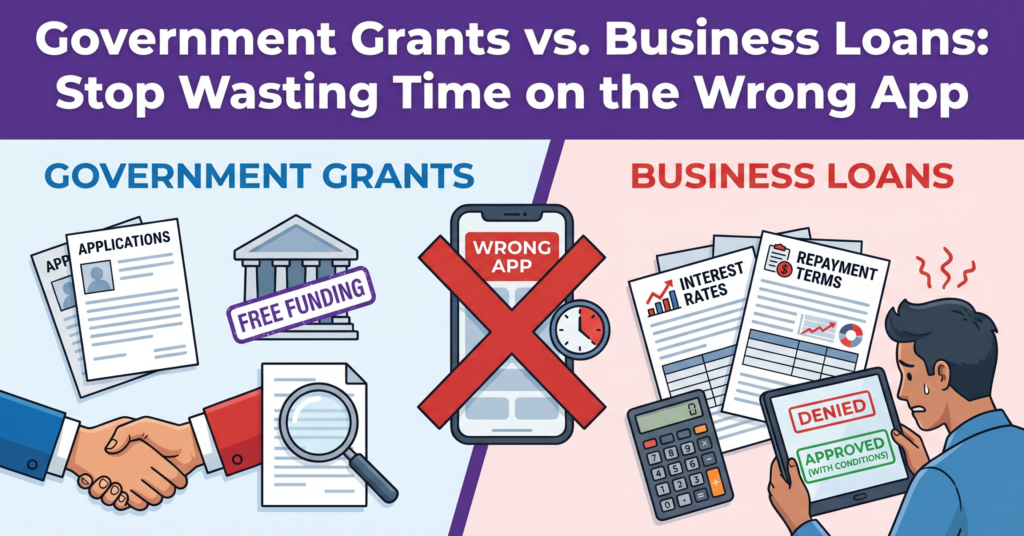
Every year, thousands of UK business owners waste months — sometimes an entire financial year — applying for funding that was never right for them in the first place. The debate around government grants vs business loans UK is one of the most misunderstood in small business finance. Entrepreneurs chase grants because they sound “free,” only to discover that eligibility windows have closed, competition is fierce, and the money won’t arrive in time to matter. Others take out expensive, ill-fitting loans when a targeted grant programme could have funded the exact same project at zero cost.
The truth? The right answer is not the same for every business. It depends on your timeline, your sector, your growth stage, and precisely what you need the money for. This guide cuts through the confusion so you can stop wasting time on the wrong application and start securing the funding that actually moves your business forward.
Table of Contents
What Are Government Grants? How They Really Work
A government grant is a sum of money awarded to a business from a public body — typically central government, a local authority, Innovate UK, or a devolved administration in Scotland, Wales, or Northern Ireland. The defining feature is that grants do not need to be repaid. That is enormously appealing, and rightly so.
However, grants come with conditions that many business owners underestimate:
- Restricted purpose: The money must be used for the exact purpose stated in the application — R&D, green tech, job creation, specific equipment, etc.
- Match funding requirements: Many grants require you to contribute a proportion of the total project cost yourself (often 30–50%).
- Competitive application process: You are competing against dozens or hundreds of other businesses for a fixed pot of money.
- Long timelines: From application to decision can take 3 to 12 months — sometimes longer.
- Reporting obligations: Post-award, you may be required to submit detailed financial reports, attend reviews, and meet specific milestones.
Popular UK grant programmes include Innovate UK Smart Grants, the UK Shared Prosperity Fund, Growth Hubs, and various sector-specific schemes administered by local enterprise partnerships. The British Business Bank also maintains a useful directory of government-backed finance options across England, Scotland, Wales, and Northern Ireland. (Source: British Business Bank)
The bottom line on grants: They are excellent for businesses pursuing innovation, green initiatives, or specific community development goals — and that have the time and capacity to run a meticulous, multi-stage application.
What Are Business Loans? A Plain-English Overview
A business loan is a sum of money borrowed from a lender — a bank, alternative lender, or finance platform — that you repay over an agreed term with interest. Unlike grants, business loans are accessible to a far wider range of businesses, serve a much broader array of purposes, and can be approved and funded in a matter of days rather than months.
Business loans in the UK broadly fall into two categories:
- Secured loans: The borrower offers an asset (property, equipment, or business assets) as collateral. This typically unlocks larger sums and lower interest rates.
- Unsecured loans: No collateral is required. Approval is based on business performance, credit history, and affordability. Faster to arrange but may carry higher rates.
The loan landscape available to UK SMEs is far more diverse than most business owners realise. Beyond high-street bank loans, there are short-term business loans, invoice finance facilities, asset finance agreements, emergency funding lines, and long-term growth capital — each built for a specific business scenario.
Platforms like Pello Pay connect UK businesses with 50+ lenders across all these categories, matching your profile to the products most likely to approve you — without the guesswork.
Government Grants vs Business Loans: 5 Critical Differences
Understanding these five core distinctions will save you months of misdirected effort.
1. Speed of Access
Government grants typically take 3–12 months from application to funding. Some innovation grants from bodies like Innovate UK can take even longer when multiple assessment rounds are involved.
Business loans through modern lending platforms can be approved within 24–48 hours and funded within days. For businesses facing urgent cash flow pressures, waiting 6 months for a grant decision is simply not a viable option.
2. Eligibility Criteria
Grants have extremely narrow eligibility windows. You must typically operate in a specific sector (tech, green energy, creative industries), be at a certain growth stage, be based in a particular region, or be undertaking a defined type of project. Missing any one criterion means automatic disqualification.
Business loans are available to the vast majority of trading UK businesses. Most lenders require a minimum of 6–12 months trading history and a minimum annual turnover threshold — conditions the majority of SMEs can meet.
3. Flexibility of Use
Grant funding is ring-fenced. You cannot use it for general operating costs, covering payroll shortfalls, or opportunistic purchases outside the awarded project scope.
Business loans give you flexibility. Whether you need to cover a VAT bill, hire staff, purchase stock, upgrade equipment, or bridge a seasonal revenue gap — the funds are yours to direct.
4. Repayment Obligations
Grants are non-repayable — provided you comply with all post-award conditions and reporting requirements. Misuse of grant funds can trigger full repayment demands.
Business loans are repaid over an agreed term (monthly repayments with interest). This is a real cost — but it is a predictable, planned cost that does not restrict how you use the capital.
5. Probability of Success
According to the Federation of Small Businesses, grant schemes are significantly oversubscribed, with acceptance rates on competitive programmes frequently below 20%. (Source: Federation of Small Businesses)
Business loan approval rates via specialist lending platforms are considerably higher, particularly when you apply through a broker that matches your profile to the right lenders before you submit.
When Should You Apply for a Government Grant?
Grants are absolutely worth pursuing — but only in the right circumstances.
Signs a Grant Is the Right Move
- ✅ You have a clearly defined innovation or R&D project that aligns with a current funding programme
- ✅ Your timeline is flexible — you can wait 6–12 months without financial strain
- ✅ You can meet match-funding requirements from existing reserves or cash flow
- ✅ You have the internal capacity to write detailed applications and maintain ongoing reporting
- ✅ Your project falls within a priority sector — green tech, life sciences, creative industries, agri-tech, etc.
- ✅ You are in a supported region, such as a Levelling Up area or an enterprise zone
If these conditions describe your business, grants are well worth the investment of time. But even then, the most sophisticated business owners pursue grants and commercial finance simultaneously — using short-term lending to bridge the gap while grant applications are assessed.
When Is a Business Loan the Smarter Choice?
For the vast majority of UK SMEs in 2026, a business loan is the practical, reliable route to growth capital. The question is simply which type of loan fits your situation.
Signs a Business Loan Is Right for You
- ✅ You need funding within days or weeks, not months
- ✅ Your funding need is operational — stock, payroll, equipment, cash flow, expansion
- ✅ You want full flexibility over how the capital is deployed
- ✅ You have been trading for at least 6 months with demonstrable revenue
- ✅ You want certainty — you know precisely how much you need and can plan repayments
- ✅ You have been declined by a high-street bank and need access to alternative lenders
Business loans are also the right tool when speed is a competitive advantage. Opportunities — a bulk stock deal, a lease on a prime premises, a contract that requires upfront capital — do not wait for grant assessment panels to convene.
Explore the full range of business loan options available through Pello Pay to find the structure that fits your goals.
The Hidden Cost of Chasing the Wrong Funding
Here is what nobody tells you about grant applications: they are expensive to write.
A competitive grant application for programmes like Innovate UK or the UK Shared Prosperity Fund can take 40–100 hours of management time to prepare correctly. Many businesses hire specialist grant writers at fees of £2,000–£10,000+ per application. And if you are unsuccessful — which, statistically, is the most likely outcome — you have spent that time and money with zero return.
More critically, while you were writing that application, a competitor may have moved faster using commercial finance. They hired the staff, bought the equipment, or secured the contract. The opportunity you were planning to fund is now gone.
The smartest UK business owners treat funding as a portfolio decision:
- Use commercial finance for fast-moving operational needs and growth opportunities
- Pursue grants as a supplementary, longer-term strategy for innovation and capital projects
- Review regularly — your eligibility for both will change as your business scales
Types of Business Loans Available to UK SMEs
One of the most common mistakes SME owners make is assuming “a business loan” means one thing — a five-year bank loan with a rigid monthly payment. In reality, the UK lending market offers a rich menu of products, each designed for a specific scenario.
Unsecured Business Loans
No assets required as collateral. Ideal for established businesses with strong trading history that need capital quickly without putting property or equipment at risk. Approval is based on your business’s financial performance and creditworthiness. Explore unsecured business loan options suited to your profile.
Secured Business Loans
By using a business or personal asset as security, you can typically access larger loan amounts at more competitive interest rates. Well-suited to businesses looking at significant capital investments or longer-term expansion programmes. See secured loan options for more detail.
Short-Term Business Loans
Designed for periods of 3–18 months, short-term loans address immediate cash flow gaps, unexpected expenses, or time-sensitive opportunities. They are fast to arrange and repaid relatively quickly, making them ideal for bridging needs.
Emergency Business Loans
When a business faces an unexpected crisis — a failed piece of critical equipment, a large supplier payment, an urgent tax liability — waiting weeks for a traditional lending process is not realistic. Emergency business loans are designed to deliver capital within 24–48 hours.
Long-Term Business Loans
For major investment — new premises, large-scale hiring, market expansion — a structured long-term loan with a repayment period of 3–10 years provides the scale and predictability needed for serious growth planning.
Asset Finance
If you need to acquire equipment, vehicles, or machinery, asset finance spreads the cost without tying up working capital. The asset itself serves as security, making this one of the most accessible finance products for growing businesses.
Invoice Finance
If your business is cash-constrained because clients are slow to pay, invoice finance unlocks the value of your outstanding invoices — turning unpaid receivables into immediate working capital.
How Pello Pay Helps You Find the Right Fit
At Pello Pay, we do not believe in a one-size-fits-all approach to business finance. Our platform is built on a “human + technology” philosophy — combining smart lender-matching across 50+ UK lenders with genuine expert guidance from brokers who understand your business.
Here is what makes us different from simply Googling “business loans”:
- Market-wide transparency: We surface a wider range of lenders than most brokers, ensuring you see real options — not just the deals that pay the highest broker commissions.
- Profile-matched lending: Before you apply anywhere, our system identifies the lenders most likely to approve your specific profile. This protects your credit file and dramatically increases approval odds.
- No hidden fees, no pressure: You compare options on your own terms. Our team is available to guide you when you want human input, not to push you toward any specific product.
- Speed with substance: A 2-minute form. Offers within 24 hours. But — crucially — the right offer, not just the fastest one.
Whether you have been declined by your high-street bank, are exploring funding for the first time, or want to make sure you are not overpaying on an existing facility, our brokers are here to help. Speak to a Pello Pay specialist today and get clarity on the funding path that is genuinely right for your business.
Frequently Asked Questions
Can I apply for a government grant and a business loan at the same time?
Yes — and for many businesses, this is the smartest strategy. You can use a commercial loan to fund immediate needs while a grant application is assessed. Just ensure you are not double-funding the exact same expenditure from both sources, as most grant bodies prohibit this.
Do government grants affect my ability to get a business loan?
Not directly. Lenders assessing your loan application will look at your trading history, revenue, creditworthiness, and affordability. Having received grant funding previously is generally seen as a positive indicator of a well-managed, credible business.
How long does it take to get a business loan in the UK?
Through a specialist lending platform like Pello Pay, many businesses receive offers within 24 hours and funding within 2–5 business days. High-street banks typically take 4–8 weeks for a formal lending decision.
What is the minimum turnover needed for a business loan?
Requirements vary by lender and product. Many alternative lenders on the Pello Pay platform work with businesses turning over as little as £50,000 per year, with a minimum of 6 months’ trading history. Some emergency and short-term loan products have even more flexible thresholds.
Are business loans better than grants for fast-growing UK SMEs?
For most fast-growing SMEs, business loans are the more practical primary tool — they are accessible, flexible, and fast. Grants are best used strategically, for innovation or capital projects where you meet eligibility criteria precisely. The two are not mutually exclusive.
What documents do I need to apply for a business loan?
Typical requirements include:
- Last 3–6 months’ business bank statements
- Most recent set of filed accounts (or management accounts)
- Proof of business identity and address
- Director’s personal details and credit background
- A summary of the purpose and amount of funding required
Conclusion: Stop Guessing, Start Growing
The government grants vs business loans UK debate does not have one universal answer — but it does have a clear framework. Grants are a powerful tool for the right business, pursuing the right project, with the right amount of time. For the majority of UK SMEs navigating the realities of 2026 — rising costs, tight cash flow, competitive markets — a flexible, well-matched business loan is the engine that keeps growth moving.
The worst outcome for your business is spending six months on a grant application you were never likely to win, while the opportunity you needed that capital for disappears. The second-worst outcome is taking the wrong type of loan — too short, too long, too secured, or too expensive — because you did not know the full range of options available to you.
At Pello Pay, our job is to make sure neither of those things happens to you.
Ready to find the right funding for your business? Contact the Pello Pay team today or take two minutes to complete our funding form at pellopay.io and receive matched offers from 50+ UK lenders — with no obligation and no impact on your credit score.