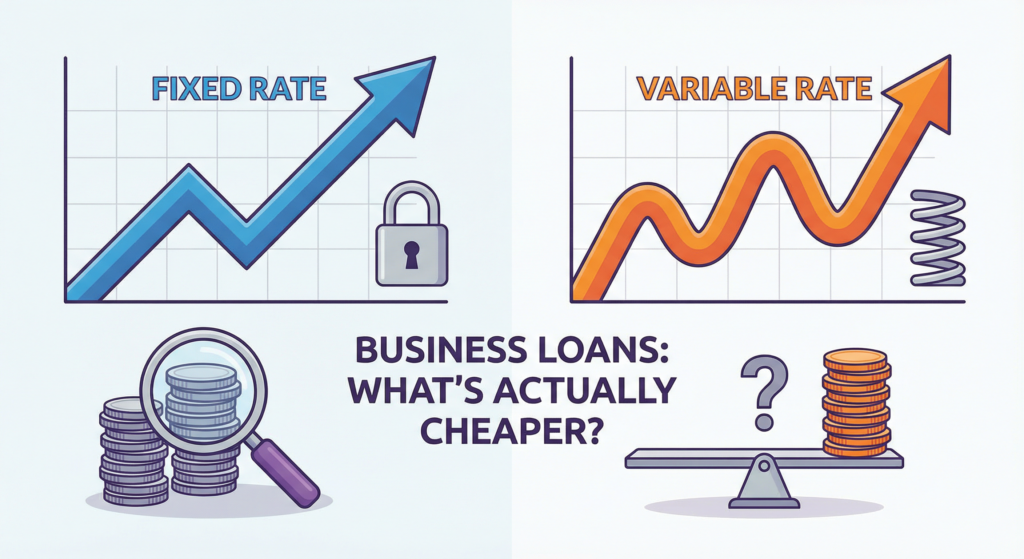
Choosing between fixed vs variable interest rates business loans is one of the most consequential decisions a UK business owner can make — yet it rarely gets the attention it deserves. You’ve done the hard work: found the right lender, agreed on a loan amount, and you’re ready to sign. Then the broker asks: “Would you prefer a fixed or variable rate?”
If your answer is a hesitant shrug, you’re not alone. For many SME owners, the difference feels abstract until it starts hitting your monthly repayments — sometimes painfully. The wrong choice can cost your business thousands of pounds over a three-to-five-year term. The right choice, however, can free up working capital, protect your margins, and give you the predictability you need to grow with confidence.
This guide cuts through the jargon. We’ll break down exactly how each rate type works, what the true costs look like in 2026, and — crucially — which option suits your specific business situation.
Table of Contents
What Is a Fixed Interest Rate on a Business Loan?
A fixed interest rate means the interest charged on your business loan stays the same for the entire duration of the loan term — or for a defined fixed period. Your monthly repayment amount is identical from month one to month thirty-six (or however long your term runs).
Key characteristics of a fixed rate business loan:
- Monthly repayments are predictable and consistent
- The rate is set at the point of agreement and does not move
- Typically available on terms from 12 months up to 10 years
- Often (but not always) slightly higher than variable rates at the time of borrowing
- Lenders price in a “security premium” — you pay a little more for the certainty
Fixed rates are the preferred choice for business owners who prioritise budget certainty. If you know exactly what’s going out of your account each month, financial planning becomes significantly easier.
What Is a Variable Interest Rate on a Business Loan?
A variable interest rate fluctuates over the life of your loan, typically tracking a benchmark rate — most commonly the Bank of England (BoE) base rate or a lender’s own Standard Variable Rate (SVR). When the base rate rises, your repayments go up. When it falls, they come down.
Key characteristics of a variable rate business loan:
- Monthly repayments can change, sometimes with very little notice
- Initial rates are often lower than fixed equivalents
- You may benefit substantially when interest rates fall
- Exposure to rate rises can strain cash flow unexpectedly
- More common in larger, longer-term commercial lending
Variable rates suit businesses that have financial flexibility — those with strong cash reserves or those borrowing over shorter periods where rate volatility has less time to compound.
Fixed vs Variable Business Loan Rates: A Side-by-Side Comparison
The table below provides a clear, at-a-glance breakdown of the core differences between fixed and variable interest rates on business loans in the UK:
| Feature | Fixed Rate | Variable Rate |
|---|---|---|
| Monthly Repayment | Stays the same throughout | Changes with benchmark rate |
| Starting Rate | Usually slightly higher | Usually slightly lower |
| Predictability | High — ideal for planning | Low — depends on market |
| Best For | Long-term loans, tight budgets | Short-term borrowing, flexible businesses |
| Risk Level | Low (to the borrower) | Medium to High |
| Early Repayment | May incur break fees | Often more flexible |
| Inflation Protection | Yes — rate locked in | No — payments can rise |
| Benefit if Rates Fall | No | Yes |
The bottom line: Fixed rates offer peace of mind. Variable rates offer potential savings — but come with real risk.
How the Bank of England Base Rate Affects Your Business Borrowing Costs
Understanding why your business loan rate moves starts with the Bank of England base rate — the single most influential number in UK lending. The BoE’s Monetary Policy Committee (MPC) meets eight times per year to set this rate, and lenders across the market adjust their pricing accordingly.
When the BoE raises the base rate, the cost of borrowing increases across the economy — including your variable rate business loan. When it cuts the rate, variable borrowers benefit almost immediately.
Between 2021 and 2023, the UK experienced its most aggressive rate-hiking cycle in decades, with the base rate climbing from a historic low of 0.1% to a peak of 5.25%. As of 2025, the BoE had begun a gradual cutting cycle, bringing rates down incrementally — though significant uncertainty remains.
(Source: Bank of England — Monetary Policy and Interest Rates)
What this means for your SME:
- If you took out a variable rate loan in 2021, your repayments likely increased significantly by 2023
- If rates continue to fall through 2026, variable borrowers could benefit
- Fixed rate borrowers remained insulated throughout — for better or worse
For business planning purposes, predicting rate movements is notoriously difficult — even for professional economists. This makes the fixed vs variable decision as much about your risk tolerance as it is about raw numbers.
Which Is Actually Cheaper? The Real Numbers Explained
Let’s put real figures on this. Assume a UK SME borrows £100,000 over 5 years (60 months). We’ll compare a fixed rate of 8.5% per annum versus a variable rate that starts at 7.5% per annum.
Scenario A: Fixed Rate at 8.5%
- Monthly repayment: ~£2,052
- Total repaid over 5 years: ~£123,120
- Total interest paid: ~£23,120
Scenario B: Variable Rate Starting at 7.5%
- Year 1 monthly repayment (7.5%): ~£2,003
- If rates rise by 1% in Year 2 (8.5%): ~£2,052/month
- If rates rise by a further 0.5% in Year 3 (9%): ~£2,078/month
- Approximate total interest paid (mixed rate scenario): ~£26,400
- Total repaid: ~£126,400
In this realistic scenario — where variable rates drift upward by just 1.5% over the loan term — the fixed rate borrower saves approximately £3,280. That’s money that could be reinvested in stock, staff, or equipment.
Conversely, if rates fall by 1% over the same term, the variable borrower could save a comparable sum. The critical question is: which direction do you expect rates to move?
The Federation of Small Businesses (FSB) consistently highlights that cash flow uncertainty is the single biggest financial pressure on UK small businesses. Unpredictable repayments directly contribute to that uncertainty.
(Source: Federation of Small Businesses — Small Business Index and Finance Research)
When a Fixed Rate Business Loan Makes More Sense
A fixed rate business loan is typically the smarter choice in the following circumstances:
You’re Taking Out a Long-Term Business Loan
The longer the loan term, the more time rate movements have to compound. Over five to ten years, even a modest rate rise can add thousands to your total repayment. Fixed rates eliminate that variable entirely. If you’re considering a long-term business loan for significant capital investment — such as expanding your premises or funding a multi-year growth plan — locking in your rate is usually the prudent decision.
You Need Cash Flow Certainty
If your business operates on tight margins — retail, hospitality, early-stage manufacturing — predictable monthly outgoings are non-negotiable. A fixed repayment lets you build your entire financial model around a known number. There are no unpleasant surprises on the first of the month.
You’re Borrowing in a Low-Rate Environment
When rates are historically low, locking in a fixed rate protects you from future rises. You essentially transfer the rate risk to the lender. Many UK business owners who locked in fixed rates in 2020–2021 found themselves paying well below market rate by 2023.
You’re Using the Loan for a Secured Asset
If you’re borrowing against an asset — property, plant, or equipment — a secured business loan with a fixed rate gives you a clean, predictable cost of capital that maps neatly against the productive life of the asset. There’s an elegant logic to knowing your borrowing cost from start to finish.
When a Variable Rate Business Loan Makes More Sense
A variable rate business loan can be the better option in the right circumstances:
You’re Borrowing Short-Term
Over 12 to 24 months, rate volatility has far less opportunity to damage your total repayment. The initial lower rate means your early repayments are cheaper, and even if rates nudge upward, the shorter time horizon limits the total impact.
You Expect Rates to Fall
If your view — informed by BoE commentary, economic forecasts, or your own adviser — is that interest rates will continue falling, a variable rate lets your repayments drop in line. You participate in the upside of falling rates automatically.
You Have Strong Cash Reserves
Businesses with substantial working capital or reliable revenue streams can absorb repayment fluctuations without material disruption. If a £100–£200 monthly swing wouldn’t impact your operations, the variable rate’s lower starting point might offer genuine savings.
You Anticipate Early Repayment
Many fixed rate loans carry early repayment charges (ERCs) that can be substantial. If there’s a real possibility you’ll repay the loan ahead of schedule — perhaps if a large contract completes or you plan to refinance — a variable rate loan may offer greater exit flexibility.
Other Rate Factors UK SMEs Often Overlook
The fixed vs variable debate is important — but it’s not the only thing that determines what your business loan actually costs. Here are the additional factors that sophisticated borrowers keep front of mind:
Annual Percentage Rate (APR) vs. Interest Rate
Your interest rate is the base cost of borrowing. Your APR includes all associated fees — arrangement fees, broker fees, administration charges — spread over the loan term. Always compare APRs, not just headline rates. Two loans with the same interest rate can have very different APRs.
Arrangement Fees
Many lenders charge an upfront arrangement fee of 1% to 3% of the loan value. On a £200,000 loan, that’s £2,000 to £6,000 before you’ve made a single repayment. Factor this into your total cost of borrowing calculation.
Repayment Structure
Some business loans are interest-only for an initial period before switching to capital repayment. Others use a straight-line or reducing balance model. The structure dramatically affects your early cash flow exposure.
Penalty Clauses
Always read the fine print on missed payment penalties. These can compound quickly and turn a manageable loan into a serious financial burden.
Lender Type
High-street banks, challenger banks, alternative lenders, and peer-to-peer platforms all price risk differently. A specialist SME lender may offer a more competitive fixed rate than a traditional bank — particularly if your business has complex finances or a shorter trading history.
Exploring the full landscape of UK business loan options is essential before committing to any single product.
How Pello Pay Helps You Find the Right Rate for Your Business
At Pello Pay, we believe that finding the right business finance isn’t just about speed — it’s about finding the right fit. Our platform gives you access to 40+ trusted UK lenders, allowing you to compare both fixed and variable rate products side by side, in real time, with full transparency on rates, fees, and terms.
Here’s what makes Pello Pay different from a standard comparison tool:
- Human + Tech approach: Our automated matching engine narrows down your eligible options in seconds. But our expert team is always available to help you interpret those results and choose wisely.
- No credit score impact: Comparing options through Pello Pay won’t leave a footprint on your credit file.
- Whole-of-market access: We’re not tied to any single lender. That means our recommendations are genuinely impartial.
- Plain-English explanations: No jargon. No buzzwords. Just clear information you can act on.
Whether you’re weighing up a fixed rate secured loan for capital investment or a variable rate short-term facility for working capital, our brokers understand the nuances and will ensure you don’t overpay.
Ready to compare fixed and variable rate business loans from 40+ UK lenders? Speak to a Pello Pay finance specialist today — zero obligation, zero credit impact.
Frequently Asked Questions
Is a fixed or variable interest rate better for a business loan?
Neither is universally better. A fixed rate is better if you need repayment certainty and are borrowing long-term. A variable rate can be cheaper if rates fall or you’re borrowing over a short period. The right choice depends on your business’s cash flow position, risk tolerance, and outlook on interest rate movements.
Do fixed rate business loans have higher interest rates?
Generally, yes — at the point of borrowing. Lenders charge a small premium for fixed rates because they absorb the risk of rate movements on your behalf. However, over time, a fixed rate can prove cheaper if market rates rise above your locked-in level.
Can I switch from a variable to a fixed rate mid-loan?
Some lenders offer this flexibility, but it is not standard. Switching may incur administrative fees or require you to refinance entirely. Always clarify this option before signing your original loan agreement.
How does the Bank of England base rate affect my fixed rate business loan?
If your rate is fixed, Bank of England base rate changes have no effect on your repayments. Your rate remains exactly as agreed at the outset. This is one of the primary benefits of choosing a fixed rate product.
What is a typical fixed interest rate for a UK business loan in 2026?
Fixed business loan rates in the UK vary widely based on loan size, term, lender type, and your business’s creditworthiness. In the current environment, rates for SME business loans typically range from around 6% to 15% per annum, with the most competitive rates reserved for well-established businesses with strong financials. Always obtain multiple quotes and compare APRs.
Are there prepayment penalties on fixed rate business loans?
Yes, many fixed rate business loans carry early repayment charges (ERCs). These compensate the lender for the interest income they lose if you repay early. The fee structure varies — some lenders charge a flat percentage, others a sliding scale based on how much of the term remains. Always review this clause carefully before committing.
The Bottom Line: Make Your Rate Decision Strategically
The debate between fixed vs variable interest rates on business loans doesn’t have a single right answer — it has the right answer for your business. Here’s the simplest framework to take away:
- Choose fixed if you value predictability, are borrowing long-term, or believe rates will rise.
- Choose variable if you value flexibility, are borrowing short-term, or believe rates will fall.
- Always compare APR, not just the headline rate.
- Never sign without understanding your early repayment terms.
The most important thing you can do is compare the full market — not just the first lender who says yes. With access to dozens of UK lenders and a team of finance specialists who genuinely understand SME lending, Pello Pay is built to make that comparison fast, transparent, and completely free.
Compare business loan rates now at Pello Pay → or contact our team to discuss your specific requirements.