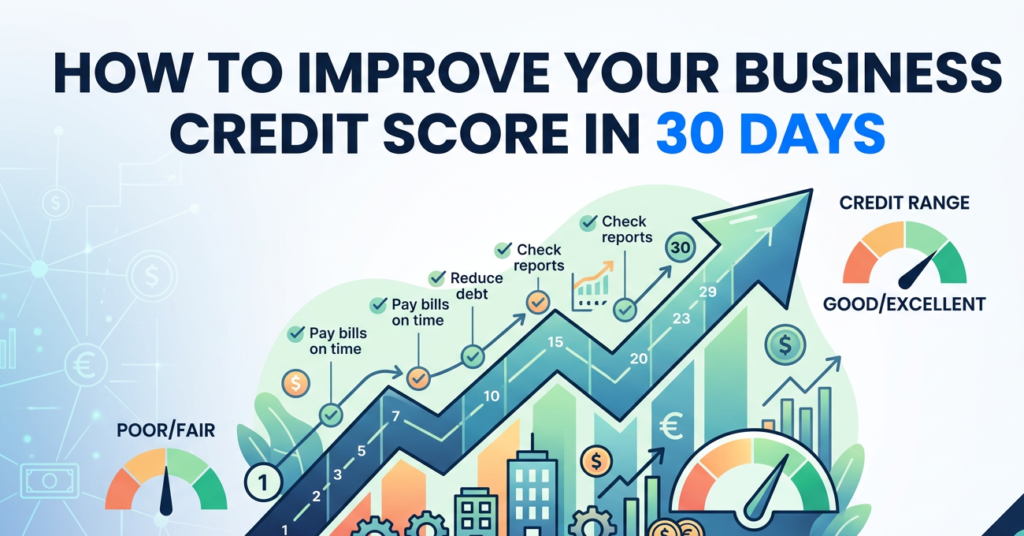
If your business has ever been declined for a loan — or offered one with punishing interest rates — there is a strong chance your business credit score was quietly working against you. For UK small and medium-sized enterprises (SMEs), a weak credit profile is one of the single biggest barriers between ambition and growth capital. The good news? You do not need months or years to turn things around. With the right actions taken consistently, it is genuinely possible to improve business credit score within 30 days.
This guide breaks down exactly how to do it — step by step, without jargon, and with real, actionable advice tailored to the realities of running a UK business in 2026.
Table of Contents
Why Your Business Credit Score Matters More Than You Think
Your business credit score is not just a number — it is your company’s financial reputation, condensed into a single rating that lenders, suppliers, landlords, and even prospective clients may review before deciding to work with you.
In the UK, the three most widely used business credit agencies are Experian Business, Creditsafe, and Equifax Business. Each uses a slightly different scoring model, but all pull from the same core data: your payment history, filed accounts, outstanding debts, and legal judgements.
According to the Federation of Small Businesses (FSB), access to affordable finance remains one of the top concerns for UK SMEs — and a poor credit score is frequently cited as the reason applications are declined or offered at unacceptable rates. (Source: Federation of Small Businesses — https://www.fsb.org.uk/research-and-policy.html)
Here is why this matters in practical terms:
- A higher business credit score means access to lower interest rates
- It can unlock unsecured lending without the need to pledge assets
- Suppliers may extend better trade credit terms
- It accelerates the approval timeline for business loans
- It provides a buffer when cashflow becomes unexpectedly tight
The bottom line: treating your business credit score as a strategic asset — not an afterthought — is one of the most commercially intelligent things you can do.
What Do UK Business Credit Agencies Actually Score?
Before you can improve your business credit score, you need to understand what is being measured. While each agency has its own proprietary algorithm, the common scoring factors across the UK landscape include:
- Payment history — Do you pay invoices, loans, and credit on time?
- Credit utilisation — How much of your available credit are you currently using?
- Length of trading history — How long has the business been actively trading?
- Companies House filings — Are your accounts and confirmation statements filed on time?
- County Court Judgements (CCJs) — Have creditors ever had to take legal action against you?
- Financial linkages — Are directors’ personal credit profiles negatively affecting the business?
- Public records — Any insolvency notices or winding-up petitions?
Understanding these factors gives you a clear map of where to focus your energy over the next 30 days.
Tip 1 — Register at Companies House and Keep It Updated
This sounds basic, but it is consistently one of the fastest, most impactful changes a business can make.
If your company is not registered at Companies House, it has virtually no credit footprint — which makes it almost impossible to access formal lending. Even if you are registered, failing to file annual accounts or confirmation statements on time is registered as a negative signal by every UK credit agency.
Action steps:
- Ensure your company is fully registered at Companies House
- File accounts before the deadline — not on the deadline
- Keep your registered address and director details current at all times
- If you are a sole trader, consider the implications of incorporation for your credit profile
This single step can begin showing positive signals on your business credit rating within days of compliance being confirmed.
Tip 2 — Separate Your Business and Personal Finances
Mixing personal and business finances is one of the most common mistakes made by early-stage UK SMEs — and it creates a tangled credit profile that hurts both.
Open a dedicated business bank account if you have not already done so. This not only makes your accounts cleaner for HMRC purposes but also begins to establish a standalone financial identity for your business. Lenders and credit agencies treat businesses with dedicated banking far more seriously than those running through personal accounts.
Additionally, if a director has personal financial difficulties — missed mortgage payments, high personal credit utilisation — this can sometimes pull down the business credit profile, particularly for sole traders and partnerships. Keeping the two distinctly separate protects both.
Quick wins:
- Open a business current account with a UK-regulated bank or challenger bank
- Apply for a business credit card (even with a modest limit) and repay it in full monthly
- Ensure all business invoices and expenses flow exclusively through business accounts
Tip 3 — Pay Suppliers and Creditors on Time, Every Time
Payment history is the single most weighted factor in almost every business credit score model. One or two late payments can undo months of positive behaviour — and the effect compounds negatively over time.
If cashflow gaps are causing late payments, this is often a sign that your current funding structure is not matched to your business cycle. Many UK SMEs operate on extended invoice terms — waiting 30, 60, or even 90 days for clients to pay while still needing to pay their own suppliers promptly. This is a structural cashflow problem, not a profitability one.
Practical steps:
- Set up direct debits for all recurring creditor payments
- Use a cashflow calendar to forecast payment obligations 90 days ahead
- Consider invoice finance if slow-paying clients are creating persistent cashflow stress — this allows you to unlock up to 90% of invoice value before the client pays
- Negotiate supplier terms proactively if a payment may be delayed — communication is always better than silence
Consistent, on-time payment is the foundation that every other credit improvement tip is built upon.
Tip 4 — Reduce Your Credit Utilisation Ratio
Your credit utilisation ratio is the percentage of your available credit that you are currently using. If you have a £50,000 business overdraft and are using £45,000 of it, your utilisation is 90% — a significant red flag for credit agencies.
The general rule of thumb used by credit professionals is to keep utilisation below 30%. This signals to lenders that your business is not in a state of financial strain and that you are managing credit responsibly.
How to improve your utilisation ratio:
- Pay down revolving credit balances where possible
- Request a credit limit increase on existing facilities (this increases available credit, reducing the utilisation percentage — without spending more)
- Avoid maxing out business credit cards, even if you repay monthly
- If you need to borrow, consider a structured short-term business loan rather than drawing heavily on revolving facilities — this can be cleaner for your credit profile
Tip 5 — Build a Positive Credit History with Smart Borrowing
Paradoxically, having no credit history can be almost as damaging as having a bad one. Lenders want evidence that your business can borrow responsibly and repay reliably.
If your business has never borrowed formally, consider starting with a small, manageable credit facility specifically to begin building a track record. A business credit card with a low limit, repaid in full each month, is one of the lowest-risk ways to generate positive credit history quickly.
For businesses ready for something more substantial, working with a specialist broker like Pello Pay allows you to access finance products that are structured for your stage of growth — from unsecured business loans for businesses with strong cashflow, to secured lending for those with assets to leverage. Each responsible repayment adds a positive data point to your credit file.
Key principles:
- Only borrow what you can confidently repay within the agreed terms
- Avoid making multiple credit applications in a short window — each hard search leaves a mark on your file
- Work with a broker who can match you to the right lender first time, avoiding unnecessary footprints
Tip 6 — Monitor and Dispute Errors on Your Credit File
This is one of the most underused credit improvement strategies available to UK businesses — and it can have an immediate impact.
Credit file errors are more common than most business owners realise. Incorrect CCJs attributed to a previous occupant of a registered address, outdated financial links to dissolved companies, or payment defaults recorded in error by creditors can all suppress your business credit rating without your knowledge.
What to do:
- Obtain your business credit reports from Experian, Creditsafe, and Equifax Business — many offer a free trial or basic free report
- Review each report carefully for inaccuracies, outdated information, or records that do not belong to your business
- Formally dispute any errors directly with the credit agency and the reporting creditor
- Follow up — disputes should be resolved within 28 days under UK regulations
According to UK Finance, data errors on credit files affect a meaningful percentage of UK businesses, and correcting a single significant error can meaningfully shift your score. (Source: UK Finance — https://www.ukfinance.org.uk/policy-and-guidance/reports-publications)
Tip 7 — Choose the Right Finance Product for Your Stage of Growth
One of the least-discussed ways to improve your business credit score over time is ensuring that the finance products you use are correctly matched to your business’s actual needs and cashflow profile.
Using an emergency loan to fund long-term equipment, for example, creates payment pressure that can lead to late repayments — damaging the very score you are trying to build. Equally, using an expensive short-term facility when a long-term loan would be more cost-effective is a structural inefficiency that compounds over time.
The right finance product at the right time looks like this:
| Business Need | Recommended Finance Product |
|---|---|
| Equipment or machinery purchase | Asset Finance |
| Short-term cashflow gap | Short-Term Business Loan |
| Covering unpaid invoices | Invoice Finance |
| Urgent, time-critical funding | Emergency Business Loan |
| Sustainable, long-term expansion | Long-Term Business Loan |
| Large capital without pledging assets | Unsecured Business Loan |
Getting this match right means repayments are sustainable, your cashflow remains stable, and every month of on-time repayment adds positively to your credit history.
How Pello Pay Helps You Access Finance at Every Credit Stage
At Pello Pay, we believe that a business credit score is a starting point — not a verdict.
Our “human + tech” approach means that when you apply for business finance through us, you are not being processed by an algorithm alone. Our experienced brokers take the time to understand your business, your sector, and your growth goals — then work across our extensive panel of lenders to find the most suitable funding solution for your specific situation.
Whether you are actively working to improve your business credit score before a major application, or you need funding right now and are unsure where to start, we have options designed for where you are today:
- Strong credit, growth-focused? → Explore our business loans and long-term funding options
- Rebuilding credit? → We work with lenders who assess the full picture, not just the score
- Asset-rich but cashflow-tight? → Asset finance and secured lending may unlock significant capital
- Time-critical need? → Our emergency loan referral service can identify rapid-turnaround options
Unlike one-dimensional platforms that rely solely on automated matching, Pello Pay provides genuine funding intelligence — the kind that helps you not just get the money, but get the right money, structured in a way that supports your long-term financial health.
💬 Ready to explore your options? Speak to a Pello Pay broker today — no obligation, no hard credit search at the enquiry stage.
Frequently Asked Questions
How quickly can I improve my business credit score in the UK?
Some improvements — such as correcting errors on your credit file or filing overdue Companies House accounts — can begin showing impact within 2–4 weeks. Structural improvements, like building a consistent payment history, take longer but compound positively over 3–6 months.
Does a business credit score affect personal credit?
For limited companies, business and personal credit are legally separate. However, for sole traders and partnerships, the distinction is much thinner. Directors providing personal guarantees on business lending may also see an impact on their personal profiles.
Can I get a business loan with a poor credit score?
Yes — though your options and rates will be affected. Working with a specialist broker like Pello Pay opens access to a wider panel of lenders, including those who specialise in lending to businesses that are rebuilding their credit profiles. Secured lending and asset finance can also be accessible options where credit scores are lower.
How do business credit agencies in the UK calculate scores?
Each agency — Experian, Equifax, and Creditsafe — uses a proprietary model, but all weight payment history most heavily, followed by credit utilisation, trading history, filed accounts, and the presence (or absence) of County Court Judgements (CCJs).
What is a good business credit score in the UK?
This varies by agency. On Experian Business, scores run from 0–100, with anything above 80 considered low risk. On Creditsafe, scores are 1–100, with 71–100 in the low-risk band. Always check which agency your prospective lender uses, as the same business may score differently across platforms.
Final Thoughts: Your 30-Day Business Credit Score Action Plan
To improve your business credit score in 30 days, your priority list should look like this:
- ✅ Verify and update your Companies House registration and filings
- ✅ Open and actively use a dedicated business bank account
- ✅ Set up direct debits for all recurring creditor payments
- ✅ Pull your credit reports from all three major UK agencies
- ✅ Dispute any errors formally and in writing
- ✅ Reduce your credit utilisation ratio below 30%
- ✅ Begin building positive credit history with a structured, manageable facility
- ✅ Work with a broker to ensure any new finance is correctly matched to your needs
A better business credit score is not a luxury — it is the key that unlocks faster approvals, lower rates, and the funding headroom your business needs to grow with confidence.
About Pello Pay Pello Pay is a UK business finance platform combining expert broker knowledge with smart technology to match SMEs with the right funding — faster. From short-term cashflow solutions to long-term growth capital, we work across the full spectrum of business finance. Learn more about us or get in touch today.
Disclaimer: This article is for informational purposes only and does not constitute financial advice. Always seek independent financial advice before making borrowing decisions.