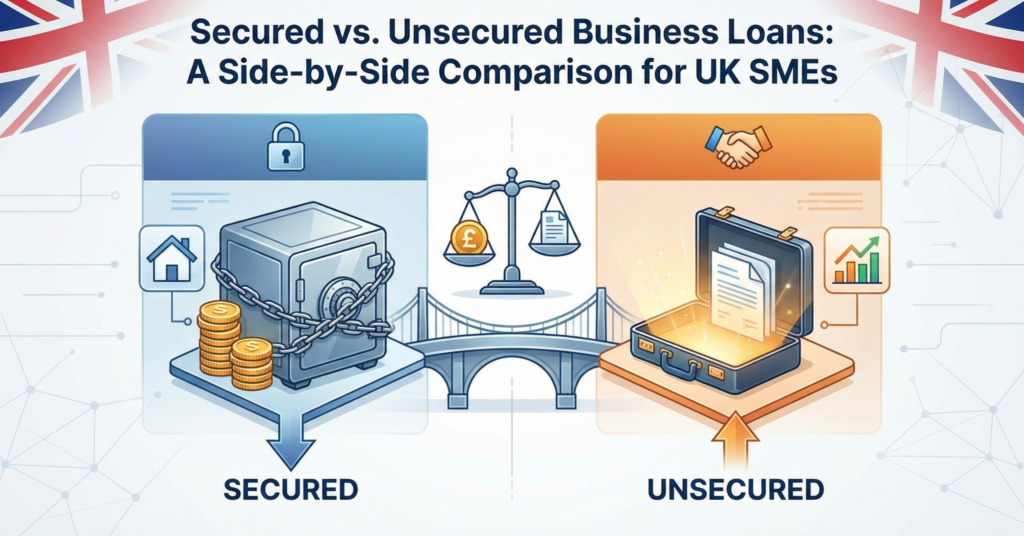
Every week, thousands of UK business owners face the same dilemma: the business is growing, an opportunity is on the table, but the bank says no — or worse, takes three months to decide. Whether you need capital to purchase new equipment, bridge a cash flow gap, or fund an expansion, choosing between secured vs unsecured business loans UK lenders offer is one of the most important financial decisions you will make.
Get it wrong and you could over-pledge assets you can’t afford to lose, or pay far more in interest than necessary. Get it right and you unlock flexible, affordable funding that matches your exact situation.
This guide cuts through the jargon. By the end, you will know precisely which loan type suits your business, what lenders look for, and how to get a decision fast.
Table of Contents
What Are Secured Business Loans?
A secured business loan is a form of commercial finance where the borrower provides an asset as collateral to guarantee the loan. If the business defaults on repayments, the lender has the legal right to seize and sell that asset to recover the outstanding debt.
This security dramatically reduces the lender’s risk — which is why secured loans typically come with lower interest rates, higher borrowing limits, and longer repayment terms compared to unsecured alternatives.
How Do Secured Business Loans Work in the UK?
When you apply for a secured business loan, the lender assesses both your creditworthiness and the value of the asset you are pledging. A formal valuation is often required, particularly for property-backed loans.
The lender then places a legal charge over the asset. This charge is registered, meaning the asset cannot be sold or refinanced without first settling the outstanding loan. Repayments are made monthly over an agreed term, typically ranging from 1 to 25 years depending on the loan size.
Common Types of Collateral Accepted by UK Lenders
Not all assets are treated equally. Here is what most UK secured business loan lenders will consider:
- 🏢 Commercial or residential property (most commonly accepted)
- 🏭 Business premises owned by the company or director
- 🚛 Plant, machinery, and vehicles (subject to valuation)
- 📦 Stock or inventory (less common, lender-dependent)
- 📑 Debentures over company assets (a floating charge over all business assets)
- 💰 Director’s personal guarantee (often combined with a charge on property)
Pello Pay Insight: Not sure which assets qualify for your secured loan application? Our specialists assess your full asset position before recommending a product. Explore our Secured Loan options →
What Are Unsecured Business Loans?
An unsecured business loan does not require you to pledge a specific asset as security. Instead, the lender assesses your business based on its trading performance, cash flow, credit history, and overall financial health. In some cases, a personal guarantee from a director may still be required — but no specific asset is charged.
Unsecured business loans are among the most popular forms of SME funding in the UK precisely because they are faster, more accessible, and do not put property or equipment at direct risk.
How Do Unsecured Business Loans Work?
Because there is no collateral for the lender to fall back on, the risk profile is higher. Lenders compensate for this by charging slightly higher interest rates and typically offering shorter loan terms (usually 1–5 years) and smaller maximum loan amounts.
The application process is far quicker. Many alternative lenders — including those on the Pello Pay platform — can deliver a decision in hours rather than weeks.
Who Are Unsecured Business Loans Best Suited For?
Unsecured loans are a strong fit for:
- Fast-growing SMEs that need quick access to working capital
- Businesses without significant tangible assets (such as service businesses or startups)
- Owners who do not want to risk personal or business property
- Companies with a strong trading history and good cash flow
- Businesses seeking smaller loan amounts (typically £1,000 to £500,000)
According to the British Business Bank’s Small Business Finance Markets Report, unsecured lending remains one of the most in-demand forms of external finance among UK SMEs. (Source: British Business Bank)
Secured vs Unsecured Business Loans UK: A Side-by-Side Comparison
The table below gives you an at-a-glance view of the fundamental differences between the two loan types. Use it as a quick reference before you speak to a funding specialist.
| Feature | Secured Business Loan | Unsecured Business Loan |
|---|---|---|
| Collateral Required | Yes — property, equipment, or assets | No specific asset required |
| Typical Loan Amount | £25,000 – £5M+ | £1,000 – £500,000 |
| Repayment Terms | 1 – 25 years | 1 – 5 years |
| Interest Rates | Lower (typically 3–8% p.a.) | Higher (typically 6–30%+ p.a.) |
| Approval Speed | Slower (days to weeks) | Faster (hours to days) |
| Risk to Borrower | Asset at risk if defaulted | No direct asset at risk (PG may apply) |
| Credit Requirement | Moderate — asset partially offsets risk | Higher — relies on credit profile |
| Best For | Large capital investment, long-term growth | Working capital, speed, flexibility |
| Ideal Business Stage | Established with tangible assets | Growing, asset-light, or urgent need |
Key Differences Explained: Secured vs Unsecured Business Loans for UK SMEs
Interest Rates and Total Cost of Borrowing
The biggest financial difference between secured vs unsecured business loans UK lenders offer comes down to cost. Because secured loans carry less risk for the lender, they reward borrowers with significantly lower annual interest rates.
For a £250,000 secured loan over five years, the difference in total repayment could amount to tens of thousands of pounds compared to an unsecured equivalent. For long-term capital projects — such as purchasing commercial premises or heavy machinery — a secured loan is almost always the more cost-effective route.
That said, unsecured loans have evolved significantly. Many alternative UK lenders now offer competitive rates to strong-performing SMEs, making the cost gap narrower than it once was.
Loan Amounts and Repayment Terms
Secured loans allow you to access substantially larger sums. With significant property or assets backing the deal, lenders are more comfortable extending millions in credit over longer horizons.
Unsecured loans are more constrained by their nature. Most UK non-bank lenders cap unsecured facilities at £250,000–£500,000 — though some specialist lenders will go higher for strong businesses.
If you need long-term, large-scale funding for a capital project, our Long-Term Business Loans page outlines the full range of options available.
Eligibility and Credit Criteria
Secured loan lenders place more weight on the quality and value of your collateral than your credit score alone. A business with a patchy trading history but strong property assets can often still qualify.
Unsecured lenders, conversely, scrutinise:
- Personal and business credit scores
- Monthly/annual revenue (minimum thresholds apply)
- Time in business (most require 6–24 months of trading)
- Bank statement health — consistent income with manageable outgoings
- Outstanding debts and existing credit facilities
Speed of Approval
This is where unsecured lending wins outright. A traditional bank secured loan can involve valuations, legal charges, and weeks of underwriting. An unsecured loan through a specialist lender can be approved and funded within 24–72 hours.
For businesses facing an urgent supplier invoice or a time-sensitive growth opportunity, speed is everything. The Federation of Small Businesses (FSB) has consistently highlighted that slow access to finance remains one of the top barriers to SME growth in the UK. (Source: Federation of Small Businesses)
Pros and Cons of Secured Business Loans
✅ Advantages
- Lower interest rates — reduces long-term cost of borrowing significantly
- Access to larger funding amounts — suitable for major capital investment
- Longer repayment terms — keeps monthly repayments manageable
- Easier to qualify if you have strong assets but a thin credit profile
- Wide range of eligible assets — property, equipment, debentures
❌ Disadvantages
- Your asset is at direct risk if you fail to repay
- Slower approval process — valuations and legal registration take time
- Less flexibility — the charge on your asset restricts what you can do with it
- Not suitable if you lack significant assets to pledge
- Personal property at risk if a personal guarantee is required against your home
Pros and Cons of Unsecured Business Loans
✅ Advantages
- No collateral required — your property and equipment are not directly at risk
- Faster decisions — often approved within hours or a single business day
- Simpler application process — less paperwork and no formal valuation
- Flexible use of funds — working capital, marketing, staffing, stock
- Widely accessible — suitable for a broad range of trading businesses
❌ Disadvantages
- Higher interest rates — reflects the greater lender risk
- Lower borrowing limits — typically up to £250,000–£500,000
- Shorter repayment terms — monthly payments can be higher
- Personal guarantee often required — directors may still carry personal liability
- Stricter revenue and credit criteria — lenders lean heavily on business performance data
Which Type of Business Loan Is Right for Your UK SME?
The honest answer is: it depends on your specific situation. There is no universally “better” option. What matters is matching the loan structure to your business goals, assets, and timeline.
Choose a Secured Business Loan If… {#choose-secured}
- You are funding a major capital purchase such as property, equipment, or a business acquisition
- You have substantial assets and are comfortable pledging them as security
- You prioritise a lower interest rate and can afford a longer decision timeline
- You need to borrow more than £250,000 for a longer-term project
- Your business has limited trading history but strong asset backing
Choose an Unsecured Business Loan If… {#choose-unsecured}
- You need fast access to working capital — within days, not weeks
- You do not own significant business assets or prefer not to put them at risk
- The loan amount you need is under £250,000
- Your business has strong monthly revenue and a healthy credit profile
- You are facing a short-term cash flow gap or seizing a time-limited opportunity
Still unsure? The decision between secured vs unsecured business loans UK lenders offer can have a major impact on your business finances for years to come. Speak to a Pello Pay funding specialist today →
How Pello Pay Helps UK SMEs Find the Right Business Loan
At Pello Pay, we take a different approach to business finance. While some platforms simply match you with the fastest lender, we believe speed without the right fit is a false economy.
Our “human + tech” model means you get the best of both worlds: smart technology that scans the market across dozens of lenders and experienced finance brokers who understand your business, your sector, and your goals.
Here is what sets Pello Pay apart:
- Whole-of-market access — we compare secured, unsecured, asset finance, invoice finance, and more
- No rigid bank criteria — we work with specialist lenders who look beyond just your credit score
- Expert guidance — our team advises on the right loan type, not just the fastest approval
- Transparent process — no hidden fees, no surprises, no pushy sales tactics
- Fast decisions — where speed is appropriate, we deliver it without cutting corners
Whether you are comparing secured vs unsecured business loans UK-wide or exploring a completely different funding route, Pello Pay has the expertise and lender network to find your best option.
👉 Ready to explore your options? Visit the Pello Pay Business Loans hub →
What Documents Will You Need?
Being prepared speeds up your application considerably. Here is a practical checklist for each loan type.
For a Secured Business Loan Application
- ✅ Last 2–3 years of filed company accounts (or SA302 for sole traders)
- ✅ Recent business bank statements (typically 6 months)
- ✅ Asset valuation or evidence of ownership (property title, equipment invoice)
- ✅ Personal and business credit history overview
- ✅ Details of any existing charges or mortgages on the asset
- ✅ Proof of business identity (Companies House registration, VAT number)
- ✅ A clear purpose for the loan and projected repayment plan
For an Unsecured Business Loan Application
- ✅ Last 6–12 months of business bank statements
- ✅ Most recent filed accounts or management accounts
- ✅ Proof of identity for all directors (passport, driving licence)
- ✅ Business plan or loan purpose statement (for larger amounts)
- ✅ Revenue and cash flow projections (often required for amounts over £100,000)
- ✅ Existing credit facility details (outstanding loans, overdrafts, leases)
Pro Tip: Having these documents ready before you apply can reduce your approval timeline from days to hours. Pello Pay’s team will guide you through exactly what each lender needs for your specific application.
Frequently Asked Questions
Can I get a secured business loan with bad credit?
Yes, in many cases. Because the lender holds a charge over a physical asset, they face less risk than with an unsecured product. A strong asset — particularly commercial property — can often offset a weaker credit profile. However, rates may be higher to reflect the elevated credit risk, and lenders will still conduct thorough checks.
What is the difference between a personal guarantee and a secured loan?
A personal guarantee is a director’s personal commitment to repay the loan if the business cannot — it does not attach to a specific asset. A secured loan places a formal legal charge over a named asset, such as property or equipment. These are distinct arrangements, though some lenders request both simultaneously, particularly for larger unsecured facilities.
How much can I borrow with an unsecured business loan in the UK?
Most UK alternative lenders offer unsecured business loans from £1,000 up to £250,000–£500,000. Some specialist lenders will go higher for established businesses with strong financials. For amounts above £500,000, a secured arrangement is almost always the more practical and cost-effective route.
Are secured vs unsecured business loans taxed differently in the UK?
No — the loan principal itself is not taxable income in either case. However, interest repayments on business loans are generally tax-deductible as a business expense, regardless of whether the loan is secured or unsecured. Always consult a qualified accountant or tax adviser for advice specific to your situation.
How quickly can I get an unsecured business loan in the UK?
With the right lender and complete documentation, decisions can be made within a few hours. Funds are typically released within 24–72 hours of approval. Secured loans take longer due to valuations and legal registration — typically 1–4 weeks from application to drawdown.
Does Pello Pay offer both secured and unsecured business loans?
Yes. Pello Pay works with a panel of specialist UK lenders to offer the full spectrum of commercial finance — including secured loans, unsecured loans, asset finance, invoice finance, and more. Our advisers help match you with the right product for your specific circumstances.
Final Thoughts: Making the Right Choice for Your Business
Understanding the real-world difference between secured vs unsecured business loans UK lenders provide is the foundation of smart SME financial planning. Neither product is inherently superior — what matters is alignment between your funding need, your asset position, and your business goals.
- Choose secured when you need scale, lower rates, and longer terms — and you have assets to back it.
- Choose unsecured when you need speed, flexibility, and simplicity — and your business performance speaks for itself.
At Pello Pay, we do not believe in one-size-fits-all finance. We believe in the right fit — for your business, your ambitions, and your circumstances. Our platform gives UK SMEs access to the full market of lenders, guided by real human expertise.
Take the first step today. Whether you are still exploring your options or ready to apply, our team is here to help.
👉 Get started with Pello Pay — speak to a funding specialist →
Pello Pay is a commercial finance broker, not a lender. All finance is subject to status and eligibility. Terms and conditions apply. Always seek independent financial advice before committing to any credit agreement.